Gibberish detector
The gibberish detector is a Tier 1 (in-process, sub-millisecond) guardrail that identifies low-quality, incoherent, or machine-garbled text in model responses. It is suited for ensuring response quality on customer-facing deployments and for catching model failure modes such as token repetition loops, encoding artefacts, or near-empty responses.
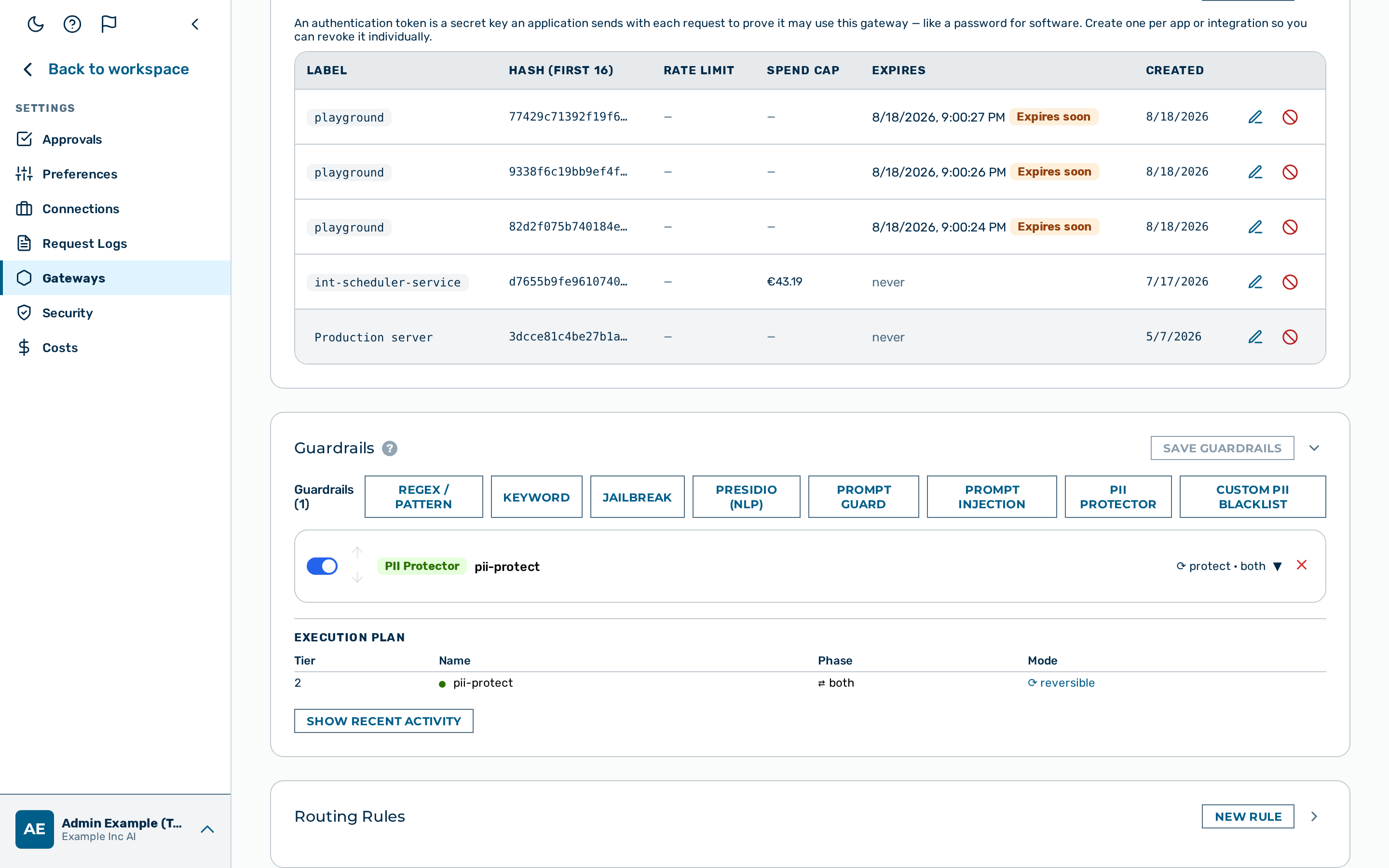 Gibberish detector editor
When to use the gibberish detector
Use the gibberish detector when you need to block or log degraded model output — responses dominated by repeated tokens, symbol floods, binary encoding artefacts, or near-empty text. It inspects model responses only.
How it works
Three independent heuristic signals are computed against the response text. Each signal that exceeds its threshold counts as one signal hit.
| Signal | Detects | Threshold |
|---|---|---|
| Shannon entropy | Character repetition — e.g. aaaaaaa… or repeated tokens |
entropy < entropy_threshold (default 2.5) |
| Word repetition ratio | Vocabulary collapse — few unique words relative to total word count | unique_words / total_words < word_repeat_ratio (default 0.15); evaluated only when the response has at least 5 words |
| Alpha character ratio | Non-text content — encoding artefacts, symbol flooding, binary data | alpha_chars / total_chars < alpha_ratio (default 0.6) |
Verdict rule:
| Signal hits | Result |
|---|---|
| 1 | Always flagged — recorded in detectors_fired, pipeline continues |
| 2 or more | Configured action applied — block or flag |
A single signal hit never blocks on its own, regardless of the configured action. Blocking requires at least two signals. This prevents false positives from short, terse, or numeric responses.
💡 Note: Responses shorter than 20 characters are always passed without inspection. Very short responses (e.g.
"Yes.") produce unreliable heuristic scores.💡 Note: The alpha-ratio check is skipped when the response is predominantly non-Latin script — when more than 30% of its bytes are high-bytes (for example Cyrillic, Arabic, or CJK text). Such scripts are legitimately low in Latin alphabetic characters, so the ratio check would otherwise misfire.
Configuration reference
| Field | Type | Default | Description |
|---|---|---|---|
type |
string | — | Must be "gibberish" |
name |
string | — | Human-readable label for this guardrail instance |
action |
string | "block" |
What to do when 2 or more signals fire: block or flag |
target |
string | "request" |
Set this to "response" — the detector inspects model output only. The orchestrator default is "request", in which phase the detector never runs, so omitting target makes it a silent no-op. "target": "response" is required. |
entropy_threshold |
number | 2.5 |
Shannon entropy threshold. Responses with character entropy below this value are flagged as repetitive |
word_repeat_ratio |
number | 0.15 |
Minimum unique-word ratio. Responses where fewer than this fraction of words are unique are flagged |
alpha_ratio |
number | 0.6 |
Minimum alphabetic character ratio. Responses that are mostly non-alphabetic are flagged |
💡 Note: The gibberish detector inspects model responses only, so
"target": "response"must be set explicitly. The orchestrator defaults an absenttargetto"request", in which phase the detector does nothing — omittingtargetsilently disables it.
Threshold tuning
| Signal | Default | Loosen (fewer blocks) | Tighten (more blocks) |
|---|---|---|---|
entropy_threshold |
2.5 |
Lower (e.g. 2.0) |
Raise (e.g. 3.0) |
word_repeat_ratio |
0.15 |
Lower (e.g. 0.05) |
Raise (e.g. 0.25) |
alpha_ratio |
0.6 |
Lower (e.g. 0.4) |
Raise (e.g. 0.75) |
Example configurations
Block gibberish responses (default configuration)
Blocks responses that score badly on at least two of the three signals.
Flag only — monitoring mode
Records suspected gibberish in the log without disrupting the client:
Strict quality enforcement
Tighter thresholds to catch more marginal responses — useful for structured-output pipelines where responses should contain well-formed prose or data:
{
"type": "gibberish",
"name": "strict-quality",
"action": "block",
"target": "response",
"entropy_threshold": 3.0,
"word_repeat_ratio": 0.25,
"alpha_ratio": 0.7
}
Configuring the gibberish detector
The gibberish detector has no card in the visual Guardrail Builder. The builder exposes only the PII protector, Presidio, Prompt Guard, regex, keyword, custom PII, and jailbreak detector types — gibberish is configured through the gateway configuration API only, by adding a detector object to the gateway's guardrails array.
Proceed as follows:
- Build the detector as a JSON object — see Example configurations above.
- Add the object to the
guardrailsarray in the gatewayconfigand send it with aPATCH /admin/v1/gateways/{id}request:
curl -X PATCH https://<your-gateway-host>/admin/v1/gateways/{id} \
-H "Content-Type: application/json" \
-d '{
"config": {
"guardrails": [
{
  "type": "gibberish",
  "name": "quality-check",
  "action": "block",
  "target": "response"
}
]
}
}'
💡 Note: The
guardrailsarray is replaced in full on eachPATCH— include every detector the gateway should keep, not only the new one.
-> The gibberish detector is saved and appears in the execution plan.
Pipeline position
The gibberish detector is Tier 1 — it runs in-process with no external calls. It executes in the response phase only. A block verdict prevents the malformed response from reaching the client.
See also
- Guardrail pipeline overview
- JSON Schema guardrail — validate structured output shape
- Language guardrail — detect non-permitted writing systems